Legislators Again Seeking Compensation for Victims of Eugenics
In 2013, North Carolina lawmakers gear up a $10 1000000 compensation fund for victims of state-sponsored eugenics. More than 780 people practical, claiming they had been forcibly or coercively sterilized by the state. At present, after an initial review, the state has decided simply most 200 of those claims are valid, while more than 500 have come up short. The applicants are either denied outright or are asked for more than data.
But we're as well now learning that the state'due south eugenics program - once idea to be managed entirely by the North Carolina Eugenics Board - was really much bigger. This fact presents problems for many seeking compensation.
Debra Blackmon's Story
In January, 1972, two social workers went to the habitation of Debra Blackmon. Blackmon was nigh to turn 14, and was intellectually disabled. It's hard to know exactly what was said, but courtroom and medical documents have some details. They signal out that Blackmon was "severely retarded" and had "psychic issues" that fabricated her difficult to manage during menstruation.
The documents say Blackmon and her parents were counseled on the thing, and that information technology was in Blackmon's best involvement that she be sterilized.
Debra Blackmon is 56 years old at present. She's sprite and funny. She has a hard time remembering too many of the details, but she remembers that mean solar day in Charlotte Memorial Hospital.
"My daddy said, 'Please don't hurt [my] infant,' and he was crying," she recalls.
"We didn't discover out until recently the extent of the surgery and what they did to her," says Latoya Adams. Adams is Blackmon's niece. She was built-in the yr after Blackmon was sterilized and grew upwardly hearing about it from older family members.

Credit Eric Mennel / WUNC
/
WUNC
Last year, the Full general Assembly created a $x million fund to compensate victims of state-sponsored eugenics, the movement that sterilized thousands of people deemed unfit to have children. Adams knew her aunt had been sterilized, she knew there were social workers involved, she knew a court had ordered the process. All the pieces seemed to fit. And so, she went looking for documentation.
She came back with the mother lode, documents that told the whole story. There was a court guild, and the consent form social workers presented to Blackmon's parents. Adams discovered documents that detailed the unabridged procedure from pre-op to discharge. The medico labeled it a "eugenics sterilization." And while it was a relief to have the information, it was besides remarkably sorry.
"They were telling my grandparents the surgery was going to be minimally invasive," Adams says. "They told them it would be a tubal ligation. And they wound up doing a full abdominal hysterectomy ... on a 14 twelvemonth quondam."
Instead of tying Blackmon'due south tubes - a potentially reversible procedure, the doctor removed her uterus. With all this testify, Adams and her family thought they had a case. They filed the paperwork, and waited to hear dorsum. The news wasn't good.
"The deprival, the only thing it stated was that at that place were no records found and that her case was not approved past the N.C. Eugenics Lath," says Adams.
What The Full general Assembly Expected Would Happen
Bob Bollinger, a lawyer representing Debra and a few other clients claiming to be victims of the sterilization policies, says that he doesn't think legislators had a full film of the issue when they created the fund.
"I don't think the individual legislator understood there were a whole bunch of sterilization cases, of involuntary sterilizations, for whom paperwork would not be found in the Eugenics Board files," says Bollinger.
When the Full general Assembly ready up the eugenics compensation fund concluding year, they gave three qualification requirements:
- You had to have been sterilized.
- You had to have been involuntarily sterilized, through force or compulsion.
- The sterilization had to have occurred nether the state-sanctioned N Carolina Eugenics Board, which operated from 1933 to 1977.

Credit Eric Mennel / WUNC
/
WUNC
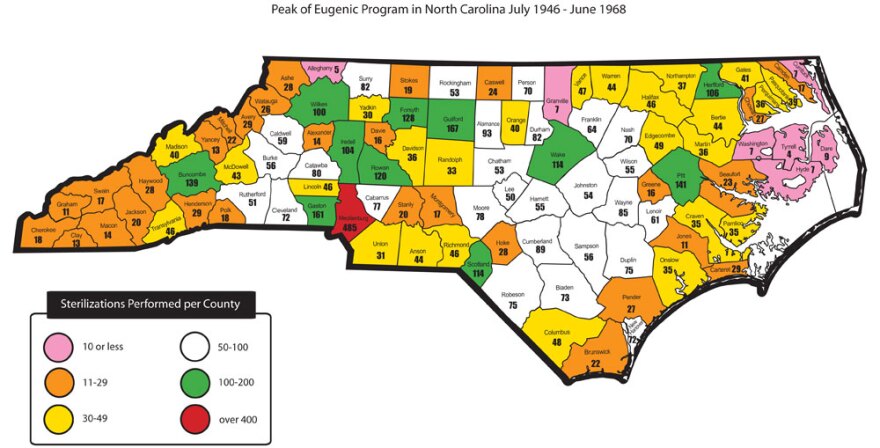
At the time, these seemed similar reasonable qualifications. To most people'due south knowledge, the Eugenics Lath was responsible for all merely maybe a few sterilizations past rogue doctors. Merely, as it turns out, the Eugenics Board wasn't the only body performing sterilizations. Judges and social service workers at the canton level were citing state law in the name of eugenics besides.
"And that's kind of become the fundamental problem here," says chaser Bollinger. "You accept some sometime dusty filing cabinet in Raleigh that'southward full of Eugenics Board paperwork from decades ago, simply yet you've got all these people sterilized involuntarily at the local level and their paperwork didn't current of air up being preserved in the eugenics files in Raleigh, if information technology was e'er there to brainstorm with."
Bollinger says Debra Blackmon is non the only victim facing this type of situation in which medical records show a "eugenics sterilization" merely there is no tape of it in the Eugenics Board files. It's impossible to know exactly how many people autumn into this loophole, though Bollinger says he'southward come up across maybe a half dozen and then far. He and other lawyers estimate at that place could exist dozens or even hundreds such cases.
Settling Claims For The Country
"A lot of people may have had this done under the auspices of local county groups. They're not qualified [for compensation.] They may think they're qualified, and they may accept had this process done to them, but if information technology wasn't under the Eugenics Board of North Carolina, they're not qualified," says Graham Wilson.
Wilson is a spokesperson for the North Carolina Industrial Committee. The Industrial Commission is essentially a grouping of lawyers that works to settle claims on behalf of the country.
Nosotros asked to speak to the grouping's commissioner, Bart Goodson. Goodson has been responsible for making decisions on all 731 claims sent to the commission so far. We weren't immune to speak with Goodson because the cases are withal being processed, only Graham Wilson spoke on his behalf.
"Is information technology perfect?" Wilson asks. "No. But it'due south new ground. While it's not perfect and we've got some folks who are not happy, the Industrial Commission is doing everything it tin can under the law every bit written to make sure people who deserve compensation get it."
County Eugenics Boards?
The idea that sterilization was done at the county level implies that there were county eugenics boards making decisions about who should and should not be sterilized. That'south not the case. Looking at Blackmon's claim, that decision was made by a commune court judge, which is part of the state court system. That judge did not cite a canton police, he cited a state police force from 1963. In fact, an before eugenics law actually required county officials to seek out individuals they accounted fit for sterilization. And the country would pay for it.
And so I asked Wilson, the spokesperson for the North Carolina Industrial Commission, "If all of the pieces of this puzzle exist considering of land policy - doesn't that brand the state liable?"
"That's hard to say," Wilson replied. "It's just something that was done. It was the way of the fourth dimension."
I pressed him, noting that the required paperwork could likely not always turn up, and Wilson said, "probably not."
Credit NC Section of Administration
/
NC Department of Administration
I was curious why the law was written this way in the commencement identify. Why were but victims who had files in the Eugenics Board records considered qualified, when many other people seemed to fit the bill, simply were only missing a single piece of paper.
I called Representative Paul Stam. Stam is the Republican Speaker Pro Tem in the Northward Carolina State Firm. Basically he is the second-in-command to Speaker (and U.S. Senate Candidate) Thom Tillis.
Stam and Tillis worked together closely to go the final compensation pecker passed in the house - a bill other legislators had been working on for a decade. Stam has written extensively on the eugenics program, and has expressed pride in getting the bounty beak passed. So I asked him "Were you fifty-fifty aware of the extent of the program? Did you know this happened outside of the eugenics lath?"
Stam: That field of study didn't even come up up.
Eric Mennel: If you were to think about that now, is that something worth because?
Stam: Interesting question. I don't make a policy decision because a reporter calls me.
Eric Mennel: That'south fine. I'1000 not request y'all to brand a policy decision. I was simply wondering would you consider information technology?
Stam: I consider everything all the time.
For the victims, it'due south frustrating. A program that was administered without particular care, where people were sterilized under state law without the state even knowing about it, is now trying to correct itself by being specially strict and narrow. For Latoya Adams, information technology feels like a double blow.
"Everything is there, it'south all in the paper work. But because you can't observe a piece of paper saying it got approved by the N.C. board, you're not going to be compensated. I recollect it's deplorable. Yous've injure her once, now I feel similar you've turned around and hurt her once again."
There is an appeals procedure - and Adams and Blackmon are working through that right now. If numbers hold, 213 people will split the $10 million, that'southward virtually $47,000 each. But the fashion it looks, Debra Blackmon volition non be among the recipients.
>>This 2011 story reports on then-Governor Bev Perdue's task force to written report the issue and determine bounty.
Source: https://www.wunc.org/law/2014-10-06/why-some-nc-sterilization-victims-wont-get-share-of-10-million-fund
0 Response to "Legislators Again Seeking Compensation for Victims of Eugenics"
Post a Comment